
By Lawrence G. McMillan
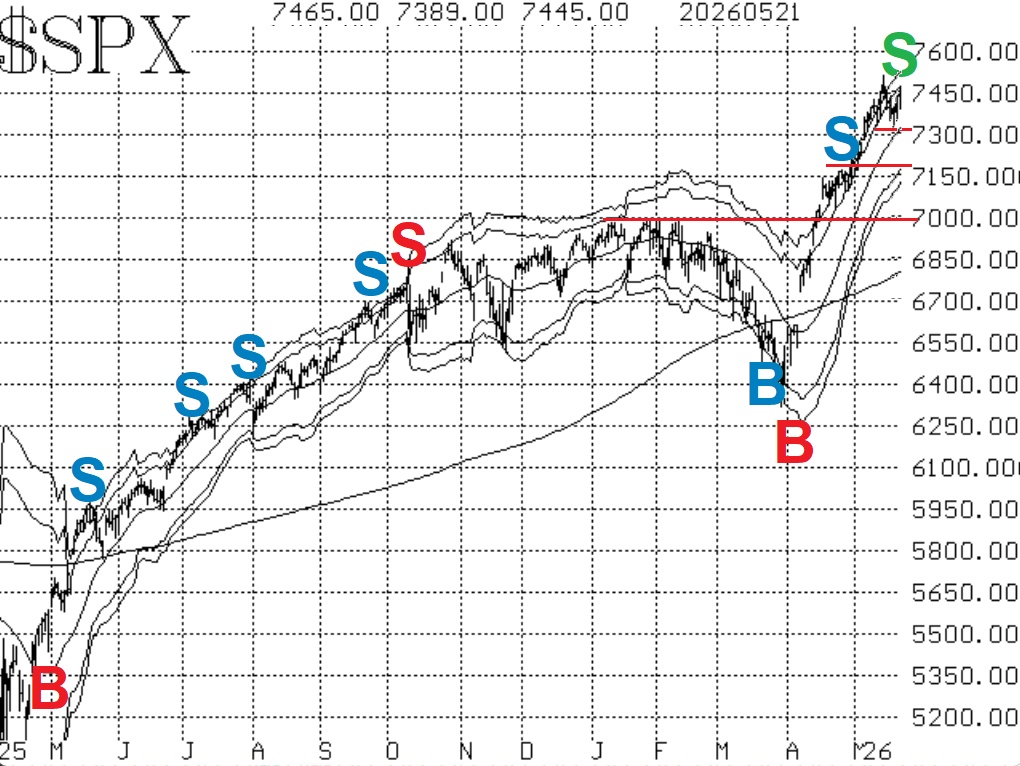
Three different internal indicators have generated sell signals over the past week or so, but the most important indicator -- the chart of $SPX remains bullish. When these conditions exist, it is usually the chart of $SPX that wins out.
$SPX had a modest pullback this past week, but it didn't even fall as far as the rising 20-day moving average. $SPX found support near 7330 (the topmost of the red horizontal support lines shown in Figure 1). Rather quietly, $SPX has bounced off of that general level three times this month.
Equity-only put-call ratios also curled upward this week, thus confirming new sell signals, both in terms of the computer analyses as well as the naked eye (Figures 2 and 3). These sell signals are coming from overbought conditions -- especially in the case of the weighted ratio.
Breadth had deteriorated enough a week ago that sell signals were generated and confirmed for both breadth oscillators. That negativity in breadth continued through May 19th, and by that time the breadth oscillators were already in oversold territory. This is our shortest-term indicator, so it can swing dramatically and quickly from one extreme to the other. Now, two strong days of positive breadth, have stopped out those breadth oscillator sell signals.
Implied volatility ($VIX) is in a neutral state. $VIX continues to hover near 18, and remains near the 20- and 200-day moving averages. See the circle on the $VIX chart in Figure 4. As long as this is the case, there is no trend of $VIX signal.
In summary, the main thing is that the $SPX chart remains bullish. In addition, there are some sell signals in place, and we have acted on those -- and we will closely watch their targets and stops. Continue to roll deeply in-the-money options.
This Market Commentary is an abbreviated version of the commentary featured in The Option Strategist Newsletter.

© 2023 The Option Strategist | McMillan Analysis Corporation